The thesis, stated upfront: in an under-served market, the binding constraint is friction and trust, not demand. We tested it with a five-day, ₹6,740 performance-marketing sprint into Valentine's and read the answer off the funnel and the order book.
01Executive summary
Three numbers carry the case: a campaign that began with no audience, a week of demand that had not existed before it, and a blended return that dwarfed the spend.
from zero followers a week earlier
in a five-day sprint
by Valentine's week
Two questions structure the rest of this study. Why the demand was latent, and how it behaved once it had a route to purchase.
02The market gap
Conclusion first: this was category creation, not share-stealing. Romantic intent in Shillong is abundant. The supply to act on it was not. Incumbent florists served weddings and funerals, cash-only and shop-front, with no delivery and no impulse product. The result was a structural gap, real willingness to gift sitting on top of no rails to do it.
We had been those buyers ourselves: the ones standing at a gate in the February drizzle because a text felt too cheap and a bouquet felt like more than we could manage. The failure was procedural rather than emotional, a blank card no one knew how to fill, a wrong bouquet, a gift you had to carry up a wet hill. Hence the operating thesis, the binding constraint was the three steps between the feeling and the doorstep. The corollary is what matters in a small market: a new brand's first competitor is the trust deficit, the discount a town applies to a name it has never heard of.
03The value proposition
The product encoded that diagnosis. A phone-first store with one non-negotiable: a checkout completable one-handed, on a bus, in under sixty seconds, because the buyer is a nervous first-timer with little tolerance for error. The decisive feature was the one we almost cut, an optional card message field.
It became our best engagement proxy. Filled on the majority of orders, unprompted, it marked an expressive category rather than a transactional one: customers were buying a way to say something, with flowers as the medium. One buyer, plainly out of his depth and knowing it, wrote:
I don't really celebrate Valentine's Day. I don't usually buy flowers either. But this felt right, because it's you. (PS: Ik I can be romantic sometimes.)
An order's card message, verbatim
The pattern held across the order book, from apologies to proposals. Reading them, we stopped feeling like operators and started feeling like we were holding the town's mail. The product takeaway is colder, and just as true: the bouquet is a permission slip, and the opt-in message rate reads latent expressive demand more honestly than any stated-preference survey.
04Go-to-market in five days
This is the part we will defend on any metric. From zero followers, ₹6,740 of paid media moved an entire small market in five days, at an efficiency that only appears when creative and latent demand are aligned.
673,300 views on ₹6,740
6,851 visits in five days
a large share of the town online
A ~₹10 CPM, sub-rupee cost per visit, and reach approaching three hundred thousand in a town of comparable size is textbook performance marketing. The playbook was deliberate. Premium brand identity, to convert the trust deficit into a sense of relief; a WhatsApp and Instagram channel mix matched to where local attention lives; emotion-led rather than price-led creative, selling the status of being the person who finally sent flowers rather than a ₹699 SKU; and disciplined timing, the full flight front-loaded three days before peak. We optimised for a starting line, not for in-flight CAC, and by Valentine's week the seed spend had returned roughly 20× in online revenue, a blended ROAS most launches never see.
05Demand under peak
Demand proved sharply occasion-concentrated. On the 13th alone, when buyers book a day early so the gift lands on the date, the shop took around 68 orders, more than two normal months in a single Friday. The week did roughly a hundred paid online orders and close to ₹1.3 lakh, peaking near ₹56,000 in a day.
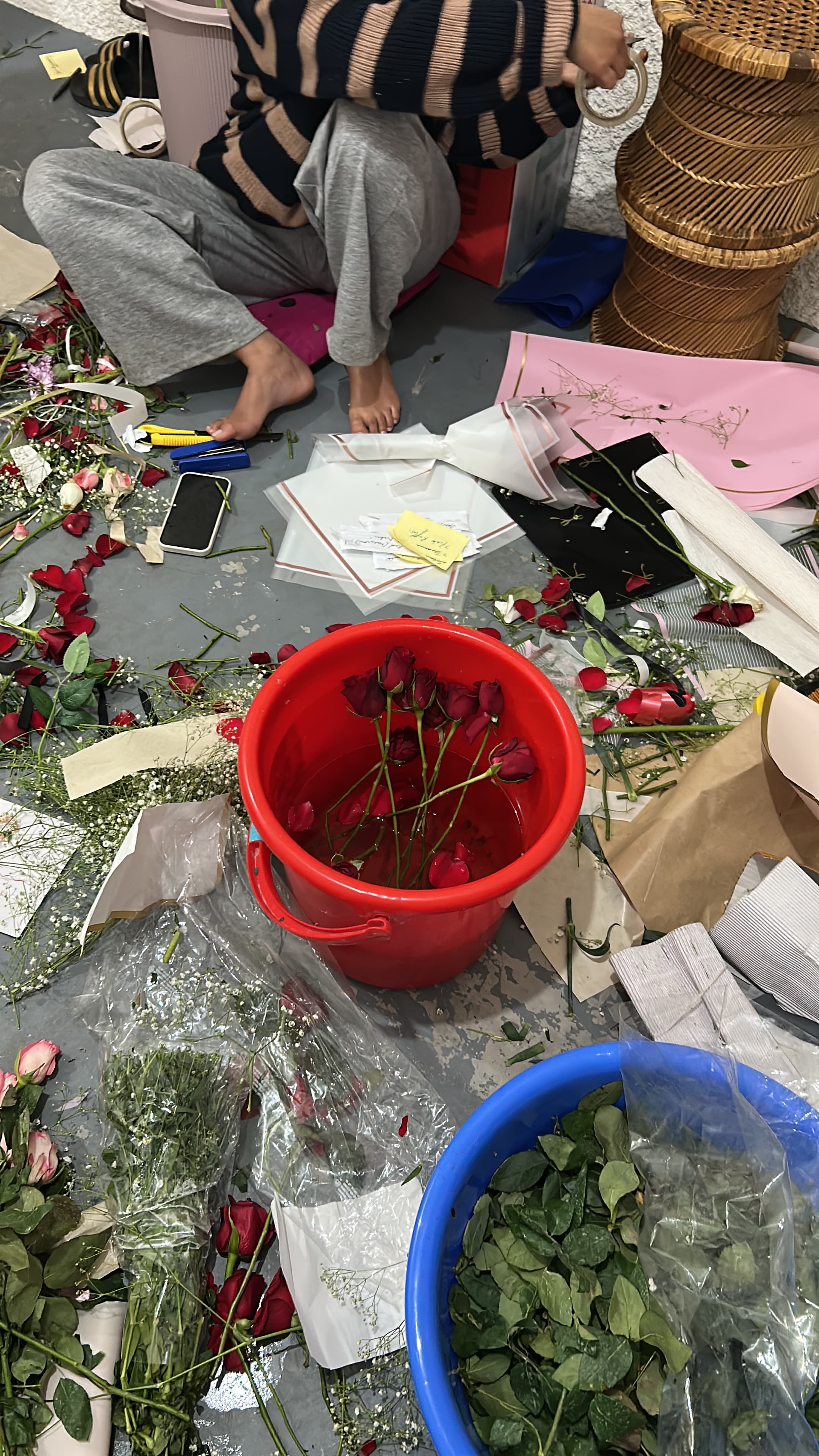
Behind that chart was a floor covered in stems and three of us wrapping past midnight, every order ping another person in town deciding to say it out loud. The binding constraint at peak was operational, not technical: perishable inventory and a thin local supply chain, one mis-picked bloom, one order refunded late at night. The takeaway is an SLA one. For same-day gifting, peak-night reliability is the product, and the worst delivery sets the brand.
Software can guarantee the price. It cannot guarantee the carnations. A same-day gifting business is only ever as good as its worst delivery on its busiest night.
The constraint the market imposed




06How the market bought
The most commercially useful finding concerns where trust gets monetised. Demand generation was almost entirely digital; conversion frequently was not. Customers discovered the brand on Instagram and WhatsApp, then transacted at the counter or by phone, and average order value split cleanly along that line.
Offline AOV was ₹1,722 against ₹1,159 online, roughly 49% higher. The implication is specific to small, low-trust markets: digital is the efficient demand-generation layer, but for a high-emotion, first-time purchase, trust, and a larger basket, still closes in person. The correct frame is O2O, a single funnel from discovery to conviction, not online versus offline.
Two further behaviours surfaced in the order data. A majority chose the fastest same-day slot over a cheaper scheduled one, a clear willingness to pay for immediacy that structurally advantages a hyperlocal operator over national next-day players. And volume concentrated on a single date, which makes off-peak demand, not peak capacity, the central growth problem.
07Under the hood
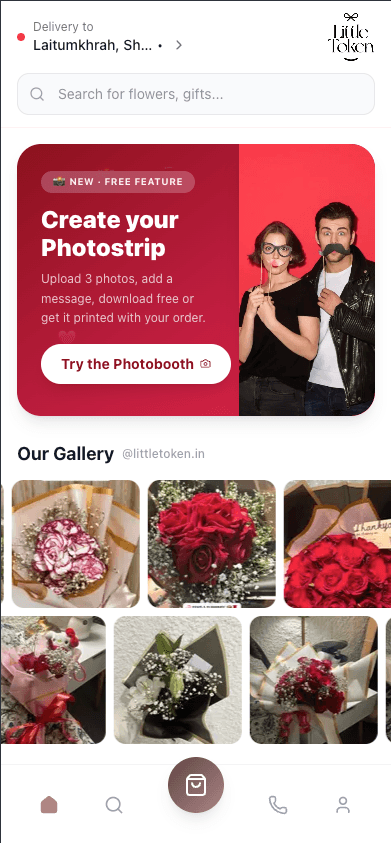
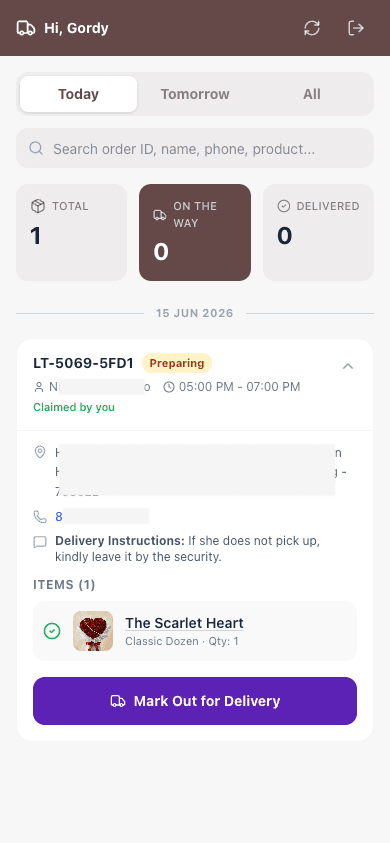
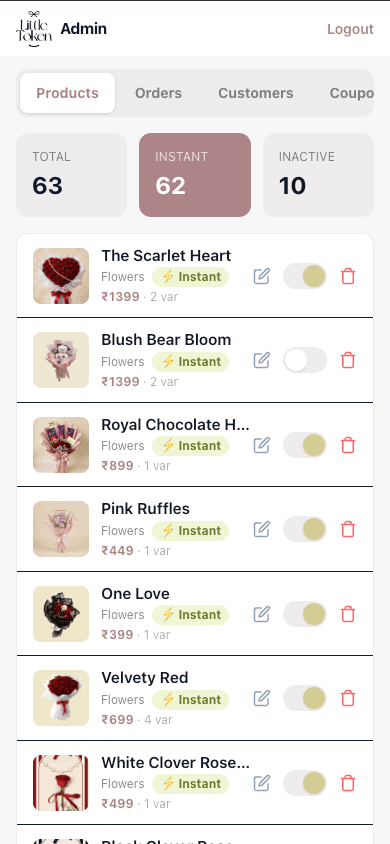
A note on the build, because it is unusual for a team this size. Little Token is a single Next.js application serving several interfaces from one codebase and one database. Three of them are operationally coupled but security-isolated: the customer storefront, the delivery-partner app, and the admin console each authenticate separately, yet all read and write a single shared Order document. A status a rider changes on the ground appears at once in the admin console and the customer's order history, because there is only ever one record.
One engineering decision shaped the money path: the phone is never trusted with the price.A determined customer can edit the line of memory that says a bouquet costs ₹699, change it to ₹1, and try to check out. So the client's price is treated as a rumour. At payment, the server rebuilds the bill from its own records and ignores whatever the client claims.
// The phone says the bouquet costs ₹1. The server does not care
// what the phone says. It rebuilds the bill from its own catalogue
// before a single rupee is charged.
const items = await Cart.lineItems(cartId);
const amount = items.reduce(
  (sum, it) => sum + CATALOGUE[it.sku].price * it.qty, 0
);                                  // our price, never theirs
const order = await razorpay.orders.create({ amount, currency: 'INR' });
// whatever the client posted as "total" is ignored entirely.
The other engineering-meets-reality call was the delivery slot, a calculated, documented risk. Each slot holds only as many gifts as the riders can carry. The safe design locks a slot the instant someone starts paying; we let it fill only once a payment cleared, leaving a known gap where several buyers can take the last spot in the same second. It is the same read-then-write race I covered in another post. We accepted it, because missing Valentine's meant missing the year. The bet held, no gift failed to arrive, but the seam is real and we know where it runs.
08Findings & roadmap
Net, this is a study of how an under-served market behaves the moment friction falls. Five findings generalise beyond gifting.
Distribution beats persuasion in under-served categories
Zero to two dozen payments in a week with no prior audience means the appetite pre-existed. We removed steps; we did not create want. Where a category is structurally under-served, build the rails before the funnel.
Opt-in expression is a leading demand signal
An optional card-message field, filled on most orders, flagged an emotional rather than transactional category. Read engagement proxies early and design the product around the sentiment, not the SKU.
O2O: digital generates demand, in-person converts trust
Offline AOV ran ~49% above online (₹1,722 versus ₹1,159). For a new name in a small market, treat the screen as demand-gen and the counter as the close, and instrument both as one funnel.
Demand is impulse-led and occasion-bound
Same-day slots out-sold cheaper scheduled ones, and volume concentrated on a single date. The demand is reactive and calendar-driven, which favours a hyperlocal model and makes off-peak weeks the real growth lever.
Premium positioning is the cheapest CAC lever
A polished identity let an unknown brand read as a relief rather than a gamble. In low-trust markets, perceived quality is not vanity; it is what lets a ₹10 CPM convert at all.
We are candid about the gaps. We shipped a documented capacity shortcut, traded knowingly against the deadline. We rode one occasion to a number the calendar will not repeat, so durability is unproven until an ordinary week performs. The roadmap follows directly: harden slot allocation for peak, manufacture off-peak demand through occasions and the photobooth pop-ups that already convert, and double down on the O2O counter that out-earns the cart. The defensible moat is not the catalogue; it is local trust and same-day speed that national players cannot replicate. We began as the under-served buyers, and the company is simply the product we wished had existed.
Little Token is live in Shillong at littletoken.in. Built and run with Balajied Sungoh, who led the brand, the campaign and the counter in Shillong.
I build scalable products from the ground up: ticketing infrastructure, government platforms, and the backend systems that hold them together under load. Little Token was a side project with Balajied Sungoh, a small store, a tight deadline, and a market that turned out to be waiting.